Sustainability Vision

Our sustainability vision will continue to influence us to make a sustainable impact on society. We are focused on realising our sustainability vision through our sustainability strategy and management of ESG elements, contributing to climate change response and the achievement of our dual carbon goals, and providing additional support and sustainable examples to the value chain.

Yuexiu Property takes into full consideration its own strategic planning, core competencies and the interrelationships with SDGs. We actively respond to the 17 SDGs, establish an optimal SDGs strategic structure, and integrate ESG concepts into the Company’s own development strategy. We are committed to operating with a responsible attitude to create sustainable environmental, social, and economic benefits. We continuously enhance our own sustainable development capabilities to become a responsible corporate citizen.

2030 Vision
Reduce carbon emission intensity of public projects and residential projects by 40% and 19% per gross floor area respectively compared to the 2019 baseline level
Reduce electricity intensity by 26% based on the 2019 level
Reduce water intensity by 11% based on the 2019 level
Use of low-carbon materials: In new projects, the utilisation rate of low-carbon buildings materials reaches 40% or above
Conduct climate risk and nature-related risk assessments for selected new construction projects
100% of newly constructed projects obtain green building certification
Utilise renewable energy to achieve a share of over 40% of renewable energy in total energy consumption
Precise management of waste during the construction process of ongoing projects
Achieve broad participation of employees and tenants in carbon eduction initiatives, and ensure that employee awareness of carbon reduction reaches over 100% through training and outreach campaigns
By 2030, at least 50% of bond and loan financing will come from sustainable finance
Sustainability Goals
Yuexiu Property deeply recognises the responsibility and mission of the Company in advancing the global sustainable development process. It firmly supports the Ten Principles of the United Nations Global Compact (UNGC) and fully integrates the Sustainable Development Goals (SDGs) into its corporate strategy and business operations. In 2025, guided by its mission of “Where Good Living Starts”, the Company systematically advanced five strategic pillars: climate resilience and nature positivity; green construction and digital empowerment; social responsibility and public welfare; compliance, risk control and prudent operations; and green finance and value synergy - achieving substantial progress towards the UN Sustainable Development Goals.
1 NO
POVERTY
2 ZERO
HUNGER
3 GOOD HEALTH
AND WELL-BEING
4 QUALITY
EDUCATION
5 GENDER
EQUALITY
6 CLEAN WATER AND SANITATION
7 AFFORDABLE AND CLEAN ENERGY
8 DECENT WORK
AND ECONOMIC GROWTH
9 INDUSTRY, INNOVATION AND INFRASTRUCTURE
10 REDUCED
INEQUALITIES
11 SUSTAINABLE CITIES AND COMMUNITIES
12 RESPONSIBLE
CONSUMPTION
AND PRODUCTION
13 CLIMATE
ACTION
14 LIFE BELOW WATER
15 LIFE
ON LAND
16 PEACE, JUSTICE AND STRONG INSTITUTIONS
17 PARTNERSHIPS FOR THE GOALS
UN SDGs
1 NO
POVERTY
Progress in 2025
  • Implemented a rural revitalisation model combining educational support with industrial empowerment, carrying out public welfare initiatives in Bijie, Guizhou Province, to cultivate endogenous momentum for rural communities
  • Built a community education and health care service system covering all ages, and provided internship and housing support for young people from Hong Kong and Macao
Outlook
  • Long-term continuous advancement of rural revitalisation and empowerment of vulnerable groups
UN SDGs
2 ZERO
HUNGER
Progress in 2025
  • During the “Spreading the Fragrance of Books in Bailidujuan” rural public welfare initiative, the Company coordinated with food enterprises under Yuexiu Group to donate nutritional supplies, paying attention to the nutritional status of rural schoolchildren
Outlook
  • Continuously carry out public welfare initiatives, focusing on the health of rural children
UN SDGs
3 GOOD HEALTH
AND WELL-BEING
Progress in 2025
  • First introduced “10+N healthy living system”, systematically enhancing residential health and comfort
  • Realised “peace of mind upon delivery” for homeowners through the “near-zero pollution furnished” system
  • The refurbishment project of Four Seasons Hotel Guangzhou introduced green construction techniques and acoustic isolation technologies
Outlook
  • Continuously promote the dissemination of healthy building technologies to enhance residents’ health and wellbeing
UN SDGs
4 QUALITY
EDUCATION
Progress in 2025
  • Cooperative education initiatives have introduced 25 high-quality public schools, providing over 38,000 school places, and established the Research Institute of Yuexiu Education
  • Innovated the “integrated medical-education” inclusive childcare model, Yuemeile Childcare Centre has been rated as a “Guangzhou Five-Star Childcare Facility”
  • Launched the “distinguished principals leading programme” and continued to support the “Hundred Enterprises, Thousand Talents” internship programme for Hong Kong and Macao university students for three consecutive years
Outlook
  • Continuously expand the coverage of high-quality educational resources and promote educational equity
UN SDGs
5 GENDER
EQUALITY
Progress in 2025
  • Implemented the women’s empowerment special programme to foster exemplary female managers and professional leaders
  • Explicitly prohibited gender discrimination, ensuring equal treatment in recruitment, promotion, compensation and other benefits, and establish a women employees’ committee
Outlook
  • Sustaining long-term gender equality in the workplace and continuously enhancing female leadership
UN SDGs
6 CLEAN WATER AND SANITATION
Progress in 2025
  • Rainwater recycling volume: 124,146 tons, condensed water recovery: 15,084 tons, watersaving faucet coverage rate over 80%, 100% compliance rate for wastewater discharge
  • Projects such as Pazhounan TOD have achieved 24-hour intelligent water quality monitoring and advanced treatment
  • No pollutant leakage incidents have occurred
Outlook
  • Achieve water neutrality by 2060 or earlier; maintain 100% compliant wastewater discharge with zero leakage in the long term
UN SDGs
7 AFFORDABLE AND CLEAN ENERGY
Progress in 2025
  • Cumulatively purchased 12,000,000 kWh of green electricity, with commercial energy management system covering 79% of property ownership area
  • Nansha iPARK Industrial Park Building D6# achieved a 47.7% reduction in building energy consumption, 100% integrated energy efficiency, and 108% renewable energy utilisation rate
  • Promoted ground-source heat pumps and air-source heat pumps in projects in Hefei, Nanjing, and other locations
Outlook
  • Purchase over 1,000,000 kWh of green power certificates by 2050; achieve over 90% coverage of energy management platforms in commercial projects by 2030
UN SDGs
8 DECENT WORK
AND ECONOMIC GROWTH
Progress in 2025
  • Issued RMB2.85 billion green dim sum bonds and signed HKD1.56 billion sustainability-linked loan
  • The proportion of sustainable finance in bond and loan financing reached 35.0%, representing an increase of 3.2 percentage points compared with 2024
  • Strictly adhered to fair employment principles and created job opportunities for new graduates and persons with disabilities
Outlook
  • Sustainable finance will account for no less than 50% by 2030 and reach 100% by 2060
UN SDGs
9 INDUSTRY, INNOVATION AND INFRASTRUCTURE
Progress in 2025
  • Comprehensively advancing AI-driven digital transformation, established the “AI Centre of Excellence”, developed nearly 90 AI agents, and received multiple industry awards.
  • The Xi’an Zunyue project implemented an intelligent construction system, introducing technologies such as AI robots
  • Independently developed the “Yuezhi AI Platform”, reducing design time by 60%; the “Yueju Code” system saved rework costs by RMB1 million per project
  • Yuehui City has introduced the “cold station AI intelligent control system”, reducing cold station energy consumption by 18.1%
Outlook
  • Continuously promote the application of AI and intelligent construction technologies, achieving 100% prefabricated construction projects by 2030
UN SDGs
10 REDUCED
INEQUALITIES
Progress in 2025
  • Provision of a substantial number of school places through joint education programmes and inclusive schools to narrow the gap in educational resources
  • Established a comprehensive age-inclusive care system, providing accessible childcare, senior education programmes, and integrated medical and elderly care services
  • Focused on groups including young people from Hong Kong and Macao as well as rural children, with support such as internship accommodation guarantees and educational assistance
Outlook
  • Long-term commitment to reducing social service and opportunity inequality
UN SDGs
11 SUSTAINABLE CITIES AND COMMUNITIES
Progress in 2025
  • All newly constructed projects achieved 100% compliance with green building standards, with a cumulative total of 243 projects completed and under construction that meet green building standards for residential projects
  • Moon Lake at Yuexiu • Naturalistic Mansion selected as GRESB “insights case study”
  • Pazhounan TOD created an AI-empowered, sustainable humanistic community
  • Liren Village’s urban village renewal was driven by collaboration among government, enterprises, and residents
  • Commercial projects received 18 WELL certifications, with three flagship projects achieving Platinum-level certification
Outlook
  • Maintain 100% green building standards continuously by 2030; achieve over 90% coverage of energy management platforms in commercial projects by 2030
UN SDGs
12 RESPONSIBLE
CONSUMPTION
AND PRODUCTION
Progress in 2025
  • The green leasing strategy was fully implemented, with a coverage rate of 100% for newly signed office building for Green Covenant
  • Prefabricated construction projects accounted for 83.9%, with the Four Seasons Hotel Guangzhou renovation reducing construction waste by 80%
  • Electronic signature coverage rate: 37%, saving 7,193 thousand sheets of paper and reducing carbon emissions by 240 tons, with 100% standardized waste treatment rate
  • Donated 35,967 books in public welfare action “Spreading the Fragrance of Books in Bailidujuan”
Outlook
  • Achieve a Green Covenant signing rate by office buildings of over 90% by 2030
  • 100% coverage of electronic signatures by 2030
  • Maintain 100% compliant waste treatment over the long term
UN SDGs
13 CLIMATE
ACTION
Progress in 2025
  • Carbon intensity of public buildings and residential buildings decreased by 33.7% and 9.4%, respectively, compared to 2019
  • Completed the estimation of Scope 3 greenhouse gas emissions across 6 categories for the first time, with total emissions amounting to 1,042,709.70 tonnes
  • The carbon credit product for the Zhonggang Leather City was listed, marking the first professional market-related building carbon credit product in the country
  • Incorporated climate performance into senior management remuneration evaluations
  • Transforming climate targets into financing actions through green finance
Outlook
  • To reduce carbon intensity of public buildings and residential buildings by 40% and 19%, respectively, by 2030
  • Achieve carbon neutrality in the value chain by 2060
UN SDGs
14 LIFE BELOW WATER
Progress in 2025
  • Yuexiu • Naturalistic Mansion Moon Lake Ecological Restoration Project established a clear-water ecological closed loop, creating a healthy habitat for native aquatic organisms
Outlook
  • Maintain long-term ecological restoration and aquatic life conservation to achieve net zero loss of biodiversity
UN SDGs
15 LIFE
ON LAND
Progress in 2025
  • Continuously optimised the Biodiversity Policy and refrain from development within protected areas
  • Guangzhou Pazhou Yue Project implemented “One Tree, One Plan” to protect 20 ancient trees
  • Conducted nature-related risk analysis for 10 priority disclosure cities in accordance with TNFD
  • Established a supply chain risk screening mechanism for natural forest deforestation
Outlook
  • Achieve 0% deforestation rate in natural forests/high conservation value forests by 2050
  • Zero violation of ecological protection regulations
UN SDGs
16 PEACE, JUSTICE AND STRONG INSTITUTIONS
Progress in 2025
  • Established a systematic compliance governance framework and integrated compliance into strategic decision-making
  • Zero tolerance for corruption, issuing anti-corruption policies, and improving whistleblower protection
  • Established an information security system, with core systems certified at level 3 of the cybersecurity protection scheme, and zero customer complaints regarding privacy
  • Incorporated prevention of greenwashing into business ethics governance and established a review mechanism for green marketing
  • Built a diversified crisis emergency management system
Outlook
  • Maintain zero corruption case, zero major information security incident, and zero ecological violation over the long term
UN SDGs
17 PARTNERSHIPS FOR THE GOALS
Progress in 2025
  • Engaged Hong Kong Quality Assurance Agency to provide third-party opinions on the Company’s Sustainable Finance Framework
  • Participated in the “2025 International Zero-Carbon City, Rural and Zero-Carbon Building Conference” to share low-carbon practices
  • Yuexiu • Naturalistic Mansion Moon Lake ecological restoration project selected as GRESB “insights case study”
  • Established a “government-enterprise-community”collaboration mechanism with government, rural villages, and communities
  • Established strategic collaboration and data sharingwith core suppliers through the “Allies Programme”
Outlook
  • Continuously deepen international cooperation and cross-sector partnerships to advance green transformation in the industry
Sustainability Strategy
Double Materiality Assessment On Sustainability Issues
In 2025, Yuexiu Property strictly aligned with the specific requirements of the Guidelines for Sustainability Reporting by Listed Companies issued by China’s three major securities exchanges, and considered the latest international trends and industry best practices, and formally advanced its assessment to encompass two dimensions: “financial materiality” and “impact materiality”. This means we not only focus on the financial implications of sustainability issues for corporate value creation, but also systematically examine the external impacts of our operations on the environment and society.
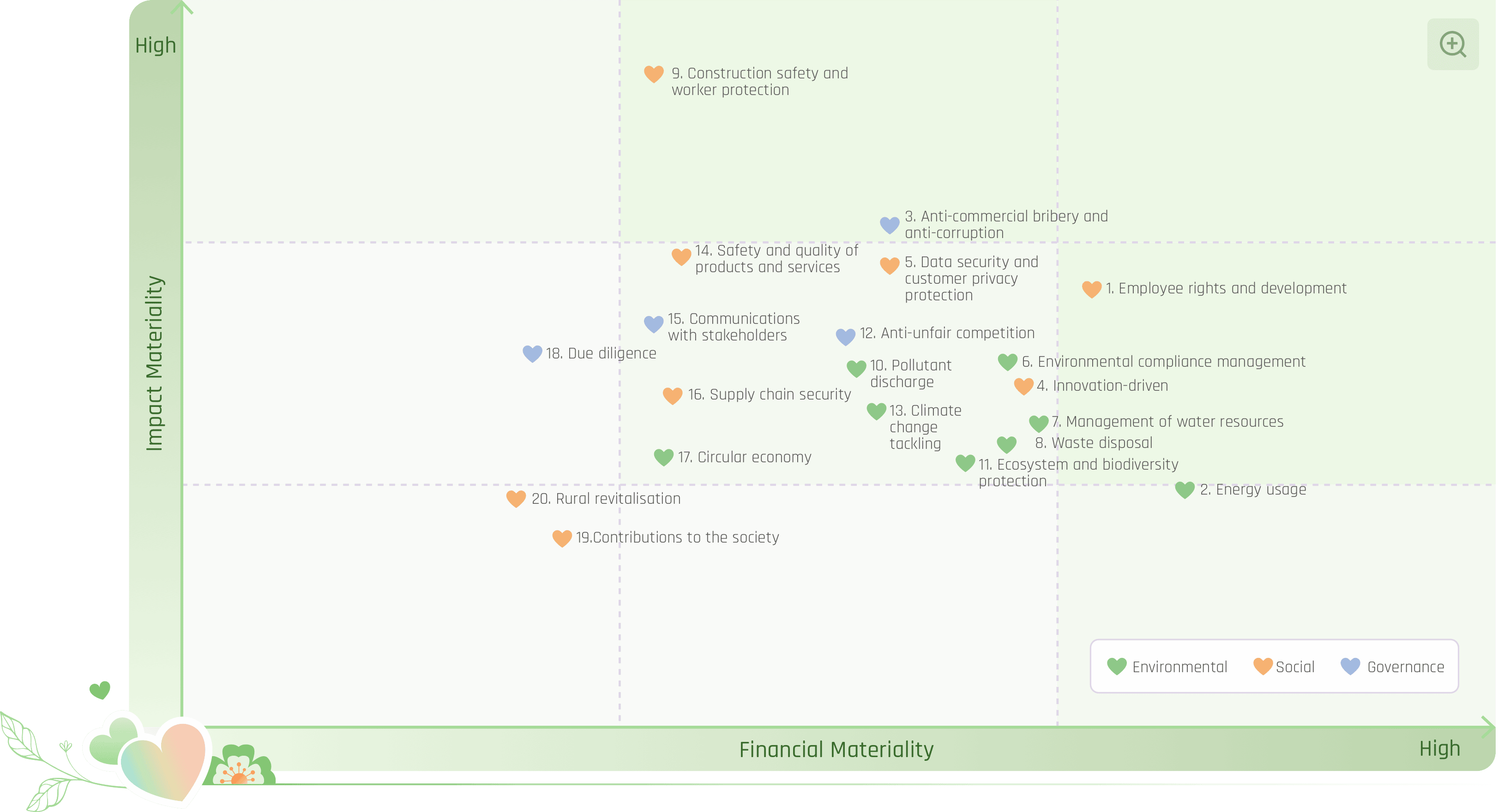
2025 Double Materiality Matrix
Five Key Sustainability Issues
2025 Double Materiality Matrix

This matrix presents the potential impact of each topic on the Company’s financial performance on the horizontal axis, and the extent of its impact on the environment and society on the vertical axis, intuitively illustrating the comprehensive materiality level of each topic and providing a scientific basis for the Company’s subsequent resource allocation and information disclosure.

  • Employee rights and development
    Employee rights and development

    Reflecting that human capital management has become a fundamental pillar of corporate sustainable development. This topic ranks high in all three categories – financial materiality, impact materiality, and overall materiality – demonstrating that employees’ career development pathways, health and safety protection, and equitable employment environments not only profoundly affect organisational stability and operational efficiency, but also play an irreplaceable role in attracting and retaining key talents and supporting long-term sustainable growth.

  • Energy usage
    Energy usage

    Under the guidance of the “Dual Carbon” strategy, energy efficiency has become a key measure of corporate operational resilience and cost competitiveness. Ranked first in financial materiality, this topic highlights the direct impact of energy management on operating costs, compliance risks, and capital market performance, driving the Company to continuously enhance the application of energy-saving and emission-reduction technologies, transforming green and low-carbon practices into tangible competitive advantages.

  • Anti-commercial bribery and anti-corruption
    Anti-commercial bribery and anti-corruption

    Against the backdrop of a business environment governed by the rule of law and stringent industry regulation, integrity, compliance, and business ethics have become the cornerstones for evaluating corporate governance capabilities and sustainable operations. This issue ranks at the forefront of importance, reflecting the central role that compliance standards and business ethics play in capital market assessments. It drives companies to continuously improve their internal control and oversight mechanisms, standardize business practices, and transform integrity and compliance into the bedrock of sound development.

  • Innovation-driven
    Innovation-driven

    Confirming that technology empowerment has evolved from an “optional strategy” to a necessity for enterprises to build long-term competitive advantages. This topic stands out in terms of financial materiality, indicating that innovative practices such as green construction, intelligent operations, and digital transformation are progressively translating into measurable cost advantages, product premiums, and financing capabilities, becoming a core driver of high-quality development.

  • Data security and customer privacy protection
    Data security and customer privacy protection

    In the digital age, customer data security has become a dual lifeline for corporate brand reputation and legal compliance. This issue ranks prominently in terms of importance, highlighting the critical impact of data governance on operational compliance, user retention, reputation, and sustainable market development. It drives companies to continuously upgrade their data protection systems and standardize end-to-end data management, thereby transforming security and compliance into a core competitive advantage for digital development.